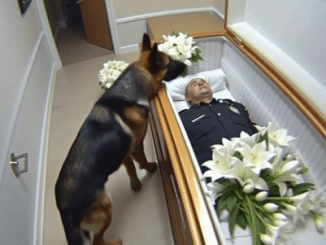
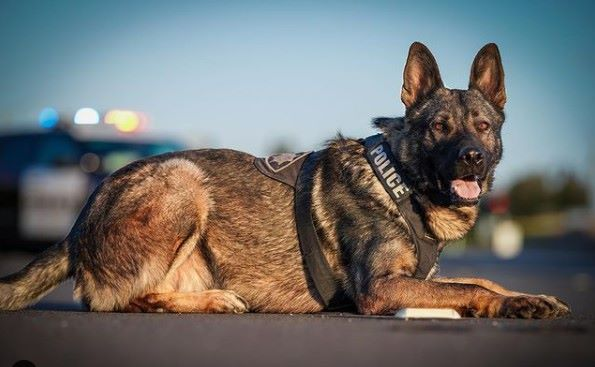
Wednesday morning at 8:43 a.m., Gate C14 hummed with airport noise—rolling suitcases, clipped announcements, tired laughter—until a German Shepherd named Max stopped mid-step and locked onto one bag.
Max didn’t just sniff and move on like usual, because this time he froze, lowered his head, and let out a sharp bark that cut through the terminal like a siren.
People instinctively stepped back, not because they understood K9 signals, but because the dog’s body language screamed certainty, the kind that makes strangers suddenly respect a routine they normally ignore.
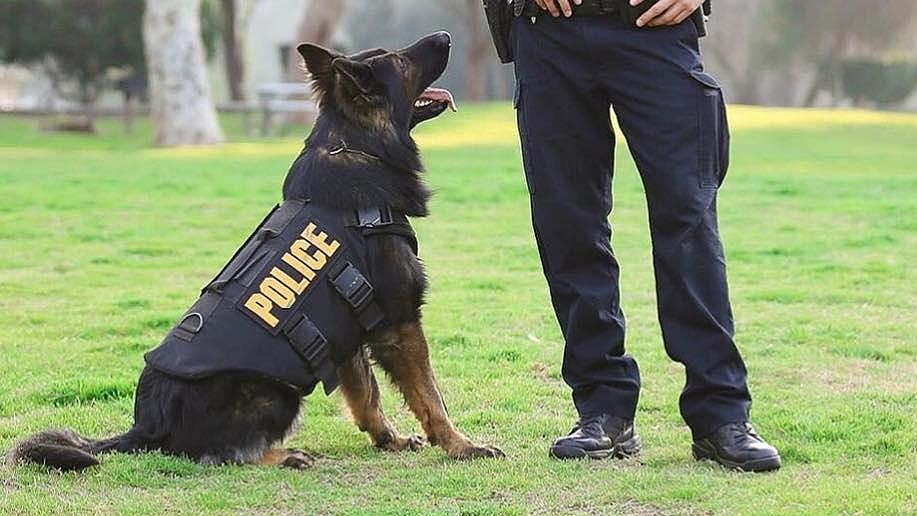
His handler, Officer Lena Ortiz, tightened the leash and scanned the floor, because Max had spent eleven years finding what other people missed, and he had never barked like that without reason.
The suitcase was ordinary on purpose—black, medium-sized, scuffed at the corners—exactly the kind of anonymous luggage that disappears into crowds, and exactly the kind criminals love for that same reason.
A man in a gray hoodie stood a few feet away, pretending to check his phone, but his eyes kept flicking toward Max, then away, then back again like a metronome of guilt.
Ortiz called out for airport security and asked nearby passengers to move behind the stanchions, and you could feel the atmosphere change from inconvenience to fear in less than ten seconds.
That’s the uncomfortable truth about airports: the place is designed to look calm, but it only takes one alert to remind everyone how fragile that calm actually is.
Within minutes, two TSA supervisors arrived, then local airport police, and then an explosives technician, because protocol doesn’t care about anyone’s connecting flight when a K9 says “stop.”
The man in the gray hoodie tried to drift backward into the foot traffic, but an officer blocked him with a polite smile that didn’t hide the command in his posture.
“Is that your bag?” Ortiz asked, and witnesses later said the man answered too quickly, too casually, as if speed could replace credibility when the dog’s bark was still echoing.
He claimed he had “just found it” near the seating area and planned to “turn it in,” which instantly split the crowd into two classic camps: believers in coincidence and believers in manipulation.
Someone behind the barrier muttered, “That’s a lie,” and someone else snapped, “You don’t know that,” and suddenly the airport wasn’t just a transit hub anymore, it was a courtroom with no judge.
Phones rose in unison, recording, zooming, narrating, because in 2025 the first instinct during danger is still to document, even when the documentation might become evidence.
The explosives technician approached the suitcase with a controlled slowness, like each step was a negotiation with fate, and Max kept barking, then whining, then barking again.
Ortiz praised him softly, the way you calm a dog while your own nerves try to climb out of your chest, because a K9 handler learns to act steady even when nothing is steady.
When the technician ran the first scan, he frowned, not dramatically, but in that subtle way professionals frown when something looks wrong in a way they can’t explain to a crowd.
He requested a second scan from another angle, and the delay made people angrier than the danger did, because waiting is what turns anxiety into rage, especially when flights are involved.
A businessman in a suit loudly complained about missing his meeting, and a mother snapped back that her kids didn’t care about his meeting if “we’re about to blow up,” sparking a round of nervous laughs.
That’s how fear behaves in public: it turns strangers into moral philosophers who argue about priorities while the real threat sits silently on the floor between them.
Security decided to move the bag to a controlled area, but Max pulled hard, barking more violently, as if he was telling them the problem wasn’t just what might explode.
Ortiz’s face tightened, because a trained dog can’t explain his logic, but he can insist with every muscle that something is deeply, terribly wrong.
They brought in a containment cart and carefully lifted the suitcase, and as it tilted, a faint sound emerged—small, rhythmic, and unmistakably alive.
At first, people thought it was a mechanical rattle, but then it came again, softer, almost like a muffled cry, and every person who heard it felt their skin go cold.
Someone whispered, “Is there… an animal in there?” and another voice answered, “No, that’s a baby,” and the crowd collectively stopped breathing like a single organism.
Ortiz shouted, “Open it now, medically,” because protocols can be bent when life is on the line, and the bomb tech nodded with the grim focus of someone choosing the least awful option.
They unzipped the suitcase with a tool, peeled back layers of clothes and foam, and discovered an inner compartment that looked custom-made, like someone had built a secret room inside luggage.
And inside that cramped space was a sedated toddler, breathing shallowly, with a strip of tape near the mouth and a wrist tag that didn’t match any airport paperwork.
The shock didn’t arrive all at once; it came in waves—gasps, screams, sobbing, then furious yelling—because people can process explosions as “events,” but a child in a suitcase feels personal.
Max stopped barking and began whining, pressing his nose toward the open bag, like he needed the humans to understand that his alert was never about objects, but about a life.
A paramedic sprinted in, lifted the toddler, and started oxygen support, while officers immediately grabbed the man in the gray hoodie, who began shouting that he “didn’t know” what was inside.
That claim detonated a different kind of chaos, because ignorance is the excuse everyone reaches for when the truth is too ugly to admit in public.
Then a second person was detained near the gate entrance, a woman who had been filming the whole time while quietly messaging someone, and suddenly the story shifted from “lone suspect” to “network.”
That shift is exactly why this kind of incident becomes viral, because people are addicted to patterns, and nothing spreads faster online than the idea that something organized is hiding in plain sight.
Airport officials tried to calm everyone with sterile statements about “an ongoing investigation,” but the crowd wasn’t listening, because human beings don’t want procedure, they want meaning.
Was this trafficking, a custody dispute, a ransom scheme, or something even darker, and why did it nearly succeed in the most monitored public space most people will ever enter?
Within an hour, clips hit social media with captions like “K9 SAVES A CHILD” and “AIRPORT COVER-UP?” and the comments turned instantly into warfare between empathy and conspiracy.
Some praised Max as a hero and demanded higher funding for K9 units, while others accused security of failing to notice anything until a dog did the work humans are paid to do.
The most disturbing question, repeated in thousands of shares, wasn’t about the suspect’s hoodie or the suitcase brand, but about how close this came to boarding a plane.
Because if a child can be sealed inside luggage at Gate C14 in broad daylight, people ask, what else is moving through our everyday systems while we stare at our screens?
Investigators later confirmed the toddler was alive and transported for emergency care, but they refused to release details about identity, which only fueled the internet’s hunger for narrative.
That hunger is a problem, because it turns real victims into trending topics, yet it’s also the reason witnesses keep coming forward, because shame dissolves faster when a spotlight appears.
By afternoon, Gate C14 reopened, flights resumed, and the terminal tried to pretend nothing happened, but the passengers who saw Max bark will never hear airport announcements the same way again.
And in the town’s group chats, family dinners, and comment sections, one argument keeps reigniting: was this a miracle of training, or proof we’re one routine morning away from disaster?