The silence in a hospital room is never complete. There’s always a distant beep, the rustling of sheets, a breath trying to match the calm promised by the white walls. That night, however, the silence seemed heavier. Not because anything was happening, but because no one imagined that, hours later, an image taken from that intimate space would circulate on thousands of screens, distorting reality beyond recognition.
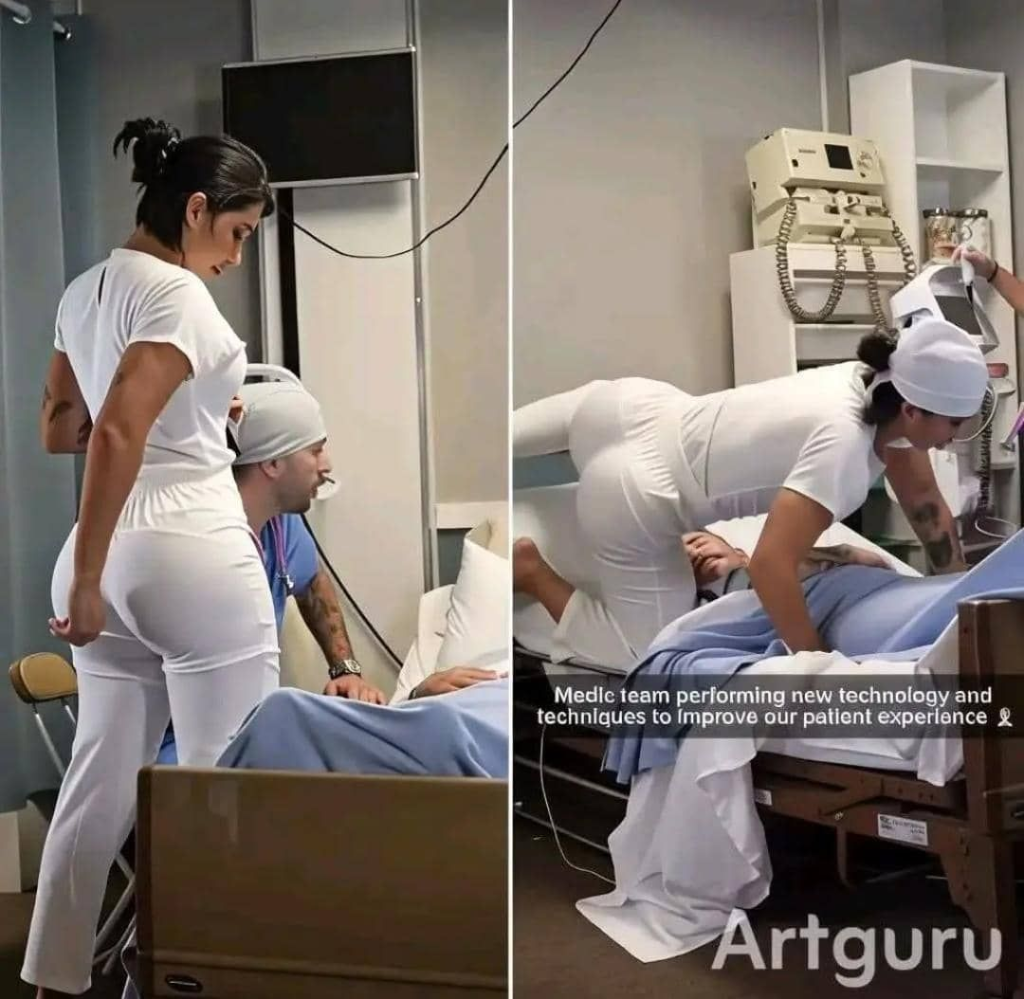
The frame shows a nurse dressed in white. Her posture is firm, focused. Her forward lean is not aggressive; it’s the learned gesture of someone who has spent years caring, supporting, and assisting. In front of her, a patient lies vulnerable, as all bodies are when they depend on others to get up, breathe better, or avoid falling. Nothing in that moment seemed out of place to those who live their daily lives among beds, monitors, and endless shifts.
But cameras don’t feel. Cameras don’t hear the context, they don’t distinguish between care and malice, they know nothing of protocols or emergencies. They only capture fragments. And fragments, when taken out of their historical context, can become weapons.
Someone took that video. Someone edited it. Someone gave it a sensationalist title, full of rage and impassioned judgment. And then the inevitable happened: outrage spread faster than the truth. Furious comments, threats, and pronouncements from people who have never set foot inside a hospital except as occasional visitors. The nurse ceased to be a professional and, in a matter of hours, became a monster invented by the narrative of the scandal.
She knew nothing at first. She was working. Putting in another shift. Trading her own exhaustion for that of others, as she had done for years. When she finally saw her name circulating, when she understood that her face was being pointed at by millions of strangers, the ground shifted beneath her feet. She hadn’t screamed, she hadn’t hit anyone, she hadn’t abused anyone. She had followed procedure. She had done what she was taught. But explaining that amidst the noise was like talking to the sea in the middle of a storm.
The patient, for his part, was also caught up in the story. His image, his body, his vulnerability exposed without permission. Transformed into a symbol of something he didn’t even fully understand. The bed where he rested was no longer a safe place, but a stage. And no one asked how he felt. No one asked what he remembered, what he understood, what he truly needed.
The hospital launched an investigation. The hallways were filled with murmurs. Colleagues lowered their voices as they passed, glances were averted, a tension that seeped into even the most routine moments. Everything had to be reviewed: the full videos, the medical reports , the testimonies. Because the truth, unlike scandal, isn’t built with headlines, but with patience.
Meanwhile, on social media, the story had already been written for many. Nuances didn’t matter. The “allegedly” didn’t matter. The condemnation was immediate and public. That’s how digital judgment works: fast, emotional, irreversible. A person can spend years building a career and lose it all in seconds, not because of what they did, but because of what others think they see.
The nights grew long for her. The white uniform hanging on a chair seemed to silently accuse her. She thought of all the times she had held trembling hands, the sleepless nights, the tears secretly wiped away behind a mask. She thought of how an everyday gesture had been reinterpreted as something sinister. And she wondered, again and again, at what point we stopped listening before pointing fingers.
The truth began to slowly emerge, as it always does. Full videos revealed what had been hidden before. Medical explanations that few wanted to read. Awkward silences where there had once been shouts. But the damage was already done. Because even if reality is reconstructed, the wounds of public exposure don’t heal with a press release.
This story isn’t just about a nurse, or a patient, or some cameras. It’s about us. About how easily we think we know everything from a single image. About how quickly we turn doubt into certainty and certainty into punishment. It’s about how dangerous it is to forget that behind every video are real people, with lives that continue when the screen goes dark.
Sometimes, the most impactful thing isn’t what the cameras show, but everything they don’t show: the context, the intention, the humanity. And it’s in that invisible space where the most important truths are often hidden.