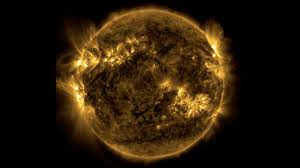
The Sun’s mysterious and multi-rhythmic heartbeat has puzzled scientists for years, and a groundbreaking new study suggests that the gravitational interactions between Venus, Earth, and Jupiter could play a key role in regulating this phenomenon. This alignment of planets may help synchronize the Sun’s internal dynamo, which generates its solar cycles. Here’s an in-depth look at how these planetary alignments might influence the Sun’s activity and the broader implications for solar physics.
Understanding the Sun’s Heartbeat and Solar Cycles
The Sun’s heartbeat refers to the rhythmic changes in solar activity, such as sunspots, solar flares, and coronal mass ejections. These fluctuations are known as solar cycles, with the most well-known being the Schwabe cycle, a cycle of about 11 years during which solar activity peaks and falls. During solar maximum, the Sun’s poles switch polarity, marking the height of solar activity. This is followed by a decrease in activity to solar minimum, after which the cycle repeats.
In addition to this long-term rhythm, scientists have also identified shorter cycles, such as the Rieger cycles, which have intrigued researchers. While the exact causes behind these cycles remain unclear, recent studies suggest that the alignment of planets may play a role.
The Role of Venus, Earth, and Jupiter
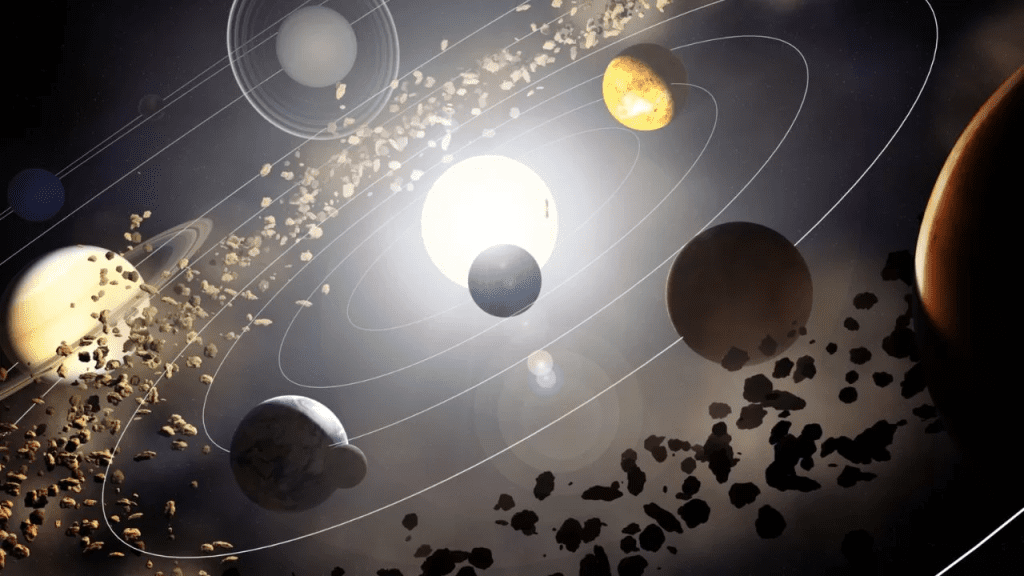
A new study, led by Dr. Frank Stefani of the Helmholtz-Zentrum Dresden-Rossendorf laboratory, proposes a fascinating theory. According to Stefani, the gravitational influence of Venus, Earth, and Jupiter can help synchronize the Sun’s dynamo, resulting in a more stable and regular solar cycle. The research found that the gravitational attraction from these three planets, especially when they align in a specific configuration, exerts a subtle yet significant influence on the Sun.
This alignment occurs approximately every 11.07 years, coinciding with the solar minimum. While the gravitational pull of the planets isn’t enough to directly affect the Sun’s interior, it is believed to provide periodic “pushes” that help regulate the Sun’s dynamo activity, resulting in a stable Schwabe cycle. This mechanism is thought to be similar to how a dynamo works, generating regular activity patterns over time.
The Discovery of Rossby Waves
One of the key findings in this study is the discovery of Rossby waves within the Sun. Rossby waves are massive, vortical waves that have been observed in the Sun’s atmosphere. These waves behave similarly to those in Earth’s atmosphere, where they influence weather patterns. The study suggests that the energy from planetary alignments can be transferred to the Sun through these waves, helping to synchronize the solar cycles.
This new understanding provides an explanation for both the Schwabe cycle and shorter cycles like the Rieger cycles, which were previously difficult to explain. The alignment of Venus, Earth, and Jupiter has been shown to not only coincide with these solar cycles but also activate Rossby waves that help modulate the Sun’s activity.
Implications for Solar Research
This research opens new doors for understanding the Sun’s behavior and its influence on space weather. By studying how planetary alignments affect the Sun’s cycles, scientists can refine their models of solar dynamics. Additionally, understanding the interaction between the Sun and the planets could offer insights into the Sun’s behavior at different stages of the solar cycle and may even help predict future solar events, such as solar flares or coronal mass ejections.
A New Frontier in Solar Physics
The discovery of the connection between planetary alignments and the Sun’s multi-rhythmic heartbeat provides valuable insights into the mechanisms governing solar activity. With the involvement of Venus, Earth, and Jupiter, scientists now have a more comprehensive understanding of how the Sun’s dynamo is synchronized. As solar research continues to evolve, these findings could play a pivotal role in advancing our understanding of the Sun’s cycles and its impact on our solar system.
By unlocking the mysteries of the Sun’s heartbeat, we are one step closer to better predicting solar activity and understanding its profound effects on space weather and Earth’s environment.